
Weight is not a single measurement.
It is a clinical profile.
Introducing the Weight Complexity Index
BMI and the number on the scales only describe part of the picture. They cannot, on their own, explain why weight has developed, how it is affecting health, or which treatment pathway may be appropriate.
The Weight Complexity Index is a structured clinical framework designed to assess the biological, metabolic, psychosocial and functional factors that contribute to excess adiposity (body fat) and obesity-related disease.
No cost. No obligation. Methodology published in full.
Not a diagnosis. The start of an assessment.
The Weight Complexity Index
The five complexity zones
The complexity zones are defined by a composite of five clinical domains, ranked 0 to 20. A zone describes your situation. It does not name a treatment, and it is not a diagnosis. Weight management requires a healthy diet and regular exercise.
Complete your preliminary assessment online
Your clinical profile is then interpreted by our multidisciplinary team:


The clinical picture
What BMI cannot show
BMI remains a useful first screen. It cannot show where adiposity is distributed, which organ systems are affected, or how weight is limiting function and quality of life. The 2025 Lancet Diabetes & Endocrinology Commission recommended moving away from diagnosing obesity on BMI alone, distinguishing clinical obesity (with organ dysfunction or functional limitation) from preclinical obesity.
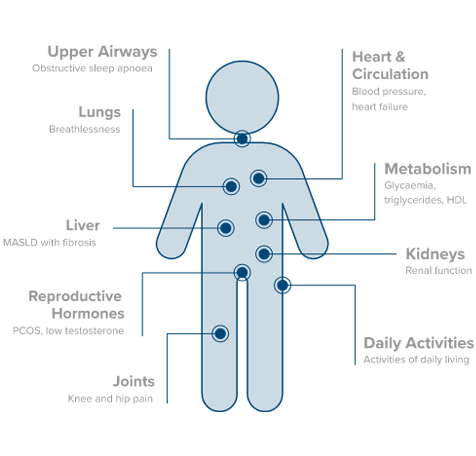
Examples of the body systems assessed
The Commission lists 18 criteria for clinical obesity in adults. None is visible on a set of scales, and each is confirmed by history, examination or pathology.
*Schematic, not anatomically exact.
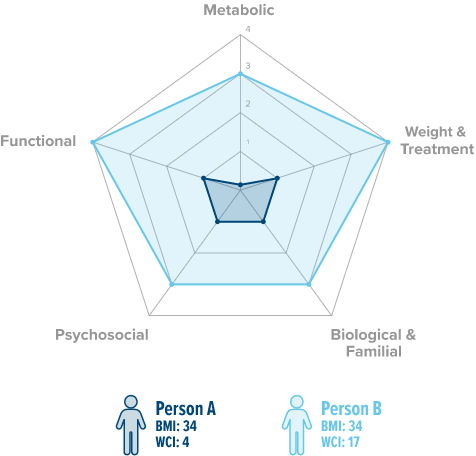
Same BMI, different clinical profile
Two people with the same BMI. One sits low across every domain. The other has metabolic comorbidity, a long history of weight cycling, a familial pattern, eating-behaviour factors and functional limitation.
BMI cannot tell them apart. The Index can.
*Illustrative profiles only, not patient data.
The five clinical domains
Rather than reducing weight to a single number, the Index builds a clinical profile across five interconnected domains
01
Metabolic & Comorbidity Profile
Anthropometrics (BMI, waist circumference and waist-to-height ratio), weight trajectory, glycaemic and lipid markers, and obesity-related comorbidities such as type 2 diabetes, hypertension, dyslipidaemia, obstructive sleep apnoea, gastro-oesophageal reflux disease (GORD) and metabolic dysfunction-associated steatotic liver disease (MASLD). Also includes current medications, endocrine factors and past medical and surgical history.
Interpreted by:
02
Weight & Treatment History
Age of onset and duration of excess weight, peak weight, weight cycling and weight regain, and previous interventions including structured lifestyle programmes, pharmacotherapy, endoscopic procedures and metabolic and bariatric surgery, with the response to each.
Interpreted by:
03
Biological & Familial Factors
Family history of obesity and type 2 diabetes, inherited predisposition, appetite and satiety regulation, endocrine and life-stage factors (such as pregnancy and menopause) and weight-promoting medications. Assessed through family and clinical history; this is not a genetic test.
Interpreted by:
04
Psychosocial & Eating Behaviour Factors
Eating behaviours (including grazing, binge eating and emotional eating), mental health history, sleep, stress, alcohol use, psychosocial support and readiness for treatment.
Interpreted by:
05
Functional & Lifestyle Impact
Functional capacity, exercise tolerance, mobility, weight-bearing joint pain, ability to perform activities of daily living, occupational demands and health-related quality of life.
Interpreted by:
What the Index does not do
It does not diagnose obesity or any other condition. It does not predict weight loss or recommend a treatment. It has not yet been validated against outcomes, which is stated here because you should know it.
Multidisciplinary interpretation
The Index is the start of the assessment, not the diagnosis
Your initial responses help us build a preliminary complexity profile. That profile is then interpreted by the relevant members of our multidisciplinary team, alongside your medical history, clinical examination and investigations.
Begin my preliminary assessmentWhy professional interpretation matters
Two people can have the same BMI and require
completely different treatment approaches
One may have significant metabolic comorbidity with relatively little functional impairment. Another may have a long history of weight cycling, mobility limitations or disordered eating behaviours that substantially alter the treatment pathway.
That is why the Weight Complexity Index does not produce a simple “good” or “bad” result. It identifies where the clinical complexity sits and what warrants further investigation.
How the assessment pathway works
From preliminary profile to individualised treatment pathway
- 01 Preliminary online
assessmentInformation on your health, weight history, previous treatment, eating behaviours and functional capacity is collected.
Get started now - 02 Preliminary
complexity profileResponses are mapped across the five clinical domains to identify areas requiring clinical review.
- 03 Multidisciplinary
clinical reviewRelevant clinicians interpret the profile alongside your medical history, clinical examination and comorbidity status.
- 04 Further investigations
where clinically indicatedDepending on your profile, this may include pathology (such as HbA1c, lipid profile, liver function and micronutrient studies), a sleep study, gastroscopy, psychological assessment or functional assessment.
- 05 Individualised
treatment pathwayBased on the complete clinical picture, and may include medical (non-surgical) weight management, dietetic and psychological support, or metabolic and bariatric surgery where clinically appropriate.
Preliminary online assessment
Begin your preliminary assessment
Five clinical domains, one question each. Your responses build a preliminary complexity profile, which is then interpreted by our multidisciplinary team.
Common questions
About the Index
Who developed the Index?
Perth Weight Loss & Surgery developed it, and says so. Its domains draw on the Edmonton Obesity Staging System, proposed in 2009 and shown in 2011 to predict mortality independently of BMI, and on the 2025 international definition of clinical obesity, developed by a commission of 56 experts and endorsed by more than 75 medical organisations. The methodology is published in full.
Why does an online assessment need a multidisciplinary team?
Because each domain is assessed differently. Metabolic comorbidity needs pathology and clinical review. Functional capacity needs a physical assessment. Eating behaviour and psychosocial factors need a clinical psychologist. The online step organises the information; the team interprets it.
Has it been validated?
Not yet, and it should be treated accordingly. It is being reviewed against our own patient records, then followed against outcomes at six and twelve months. If it does not prove clinically useful, we will say so and revise or withdraw it.
Does it test my genes?
No. It records family history, the same information your GP would ask about. Inherited predisposition is assessed clinically, not genetically.
What if my profile shows low complexity?
Then a specialist multidisciplinary service may not be what you need right now, and we will tell you that. Your GP is an appropriate next step, and your preliminary profile is yours to take with you.
Will this tell me whether I need medication or surgery?
No. Treatment decisions, including eligibility for metabolic and bariatric surgery, are made by a clinician after a full assessment. The Index ensures that conversation starts from a complete clinical picture.
Can my GP use it?
Yes, at no cost, with no licence and no referral obligation.

Copyright © 2026 Perth Weight Loss & Surgery.
All rights reserved. Site by Concept Marketing.
42 Great Northern Highway, Midland WA
(08) 6155 8822
Weight management requires a healthy diet and regular exercise. Individual results vary. The Weight Complexity Index provides general information to support a conversation with a qualified health practitioner. It is not medical advice, not a diagnosis, and not a recommendation for or against any treatment. Eligibility for any treatment is determined by a qualified health practitioner after an individual assessment. This page does not advertise or promote any specific medicine.